


Geometry in Watercolour by Alice Zakharnko

We invited Alice Zakharenko to write a guest blog for us — and we couldn’t be more excited to share it with you. Alice was awarded the prestigious GreatArt Prize for her remarkable work featured in the annual painting prize hosted by the Royal Watercolour Society.

What immediately captivated us about Alice’s work was how refreshingly different it felt within the world of watercolour. Her striking use of geometry and structure brings a bold, contemporary edge to the medium — something rarely seen, and impossible to ignore. There’s a unique rhythm and precision to her paintings that left us eager to hear more about her process, inspiration, and artistic journey.

We hope you enjoy Alice’s blog just as much as we did reading it — and perhaps discover a new perspective on what watercolour can be.
►► supplies

►► How to

►► result

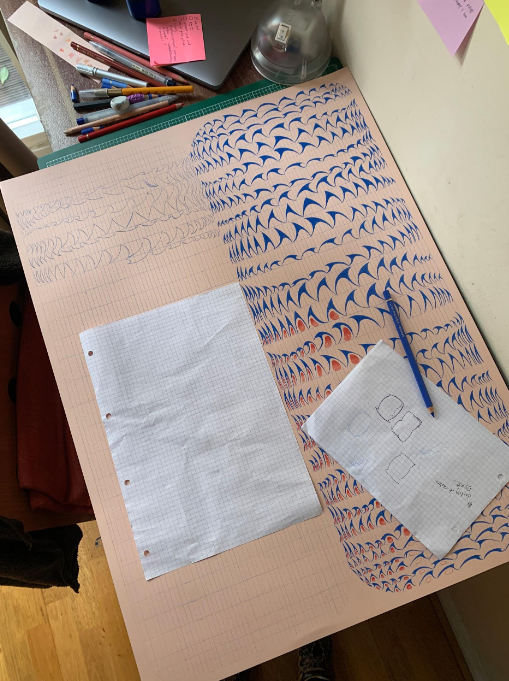
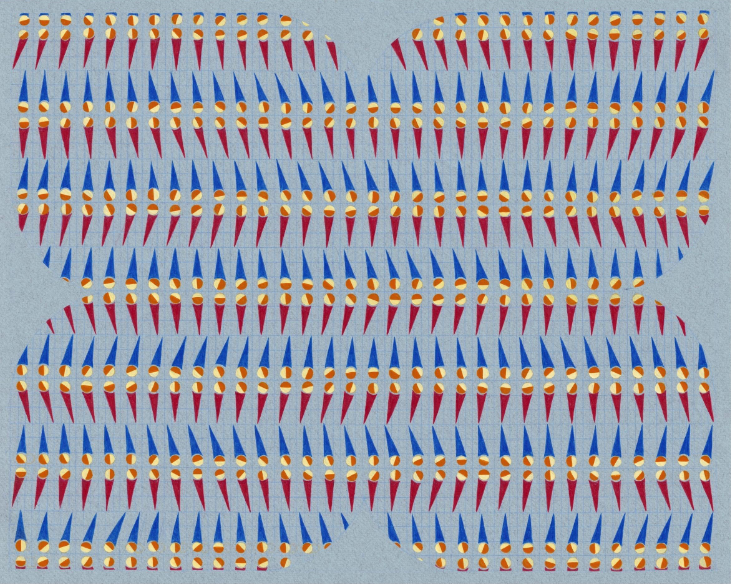
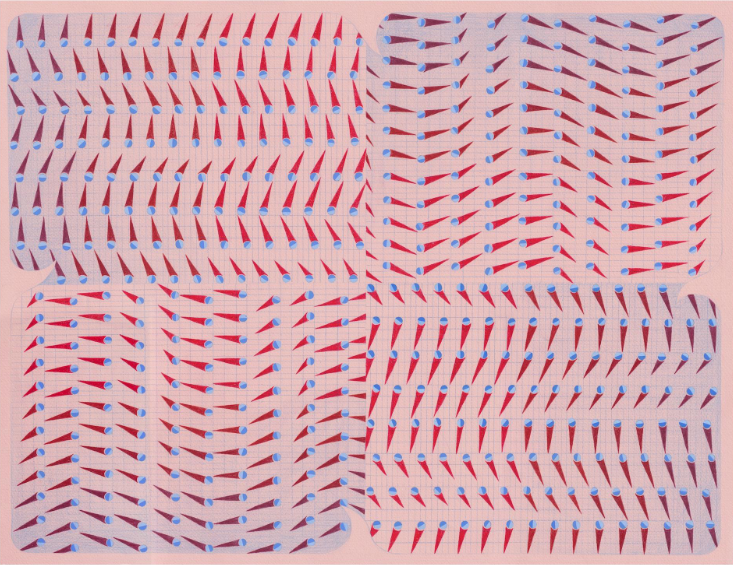
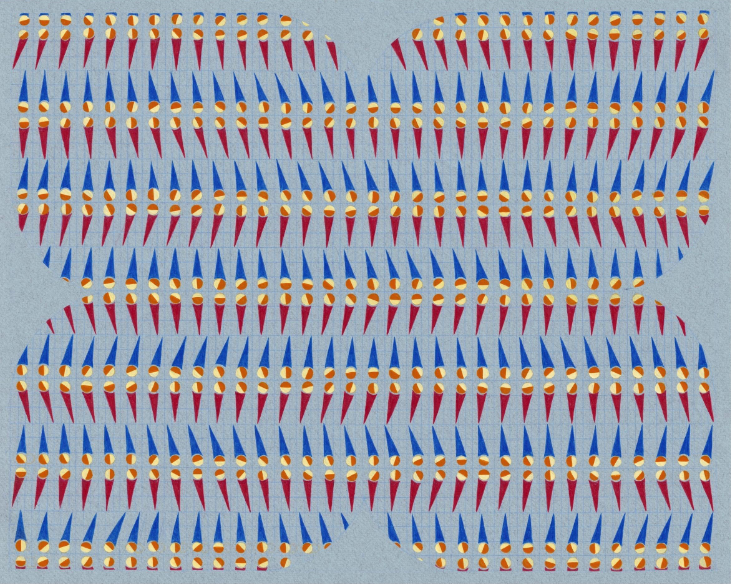
The beginning of 2026 was an interesting start. I had an opportunity to exhibit at the Royal Watercolour Society Annual Open at the Bankside Gallery. It was my second time exhibiting there and I couldn’t feel more grateful that they wanted me for another year of exhibiting. While I was unassumingly moving through the private view looking at all the other exhibitors, I thought that was it. However, when the prizes were called, to my surprise (again!), I was selected as the GreatArt prize winner. The team had kindly offered to put a piece of my writing of any kind into their magazine and offered materials that I can use in my practice such as pencils and, of course, paper. I always struggle writing about my work, not because there’s nothing to say, but I’m always stuck in how to describe the reason to do this type of repetitive work. My work explores repetition, rhythm and time through everyday materials. I work through subtle shifts in movements and I invite anyone to look closer beyond what they initially see. With that all said, my process is incredibly simple, if not mainly time consuming. This piece isn’t about how I make it, but it explores why I would be insane enough to do it.


Imagine this — You sit down to draw a triangle
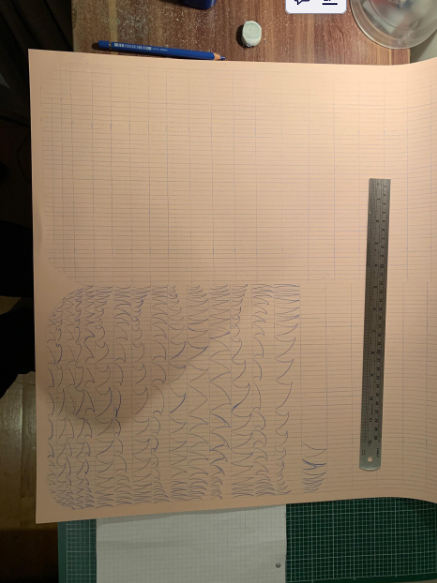

There is nothing particularly difficult about a triangle. It consists of three lines, and these lines are not
especially demanding. With a sharpener and a pencil, it is possible to produce one in a matter of
seconds, and to produce it correctly, which is to say, without incident.


What you'll need — this is what I used


How to — My thought process

You draw one. It is satisfactory. It does what a triangle is expected to do. There is no immediate reason

to draw another, except that you do. And then another.


At first, this seems harmless. There is even a small sense of order in it, a feeling that something is being

established, though it is not entirely clear what that something might be. The triangles begin to

accumulate. They resemble one another closely enough to suggest consistency, but not so closely that

they can be mistaken for copies.


Somewhere around the fiftieth, perhaps the fifty-seventh, though you are not entirely certain, because

counting begins to behave like part of the rhythm rather than a reliable measure, you notice that your

body has started to participate more insistently than before. The hand tightens in small increments. The

shoulder settles into a position it does not fully relinquish. You realise, with a kind of mild irritation rather

than alarm, that you have been holding your breath in short intervals, as if each line requires its own

approval from the lungs. The hand begins to tire, though not dramatically. It is a mild resistance, the sort

that can be ignored without consequence, and so it is ignored.
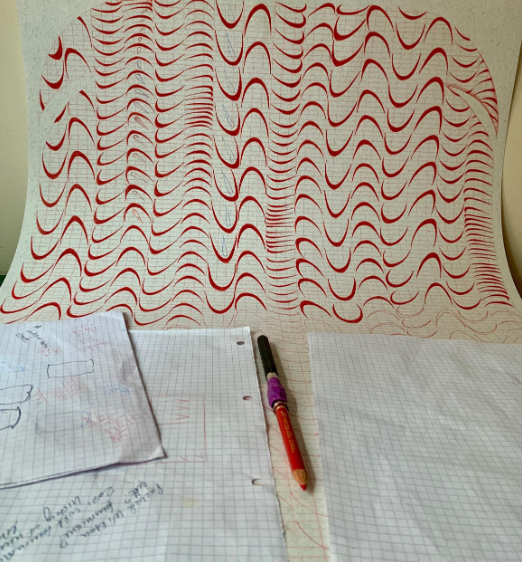

You adjust your posture, not because it solves anything, but because not adjusting feels like an

admission of neglect. You sit up straighter. You roll your shoulders back. You briefly consider whether

this is the moment one becomes permanently hunched, then decide it probably is not, and continue.


TIP! It is worth noting at this point that there are quicker ways of producing triangles. Considerably quicker.

Any computer program, for instance, would have no difficulty producing hundreds in the time it takes to

draw a handful by hand, and each would be identical to the last. This is generally considered an

advantage.
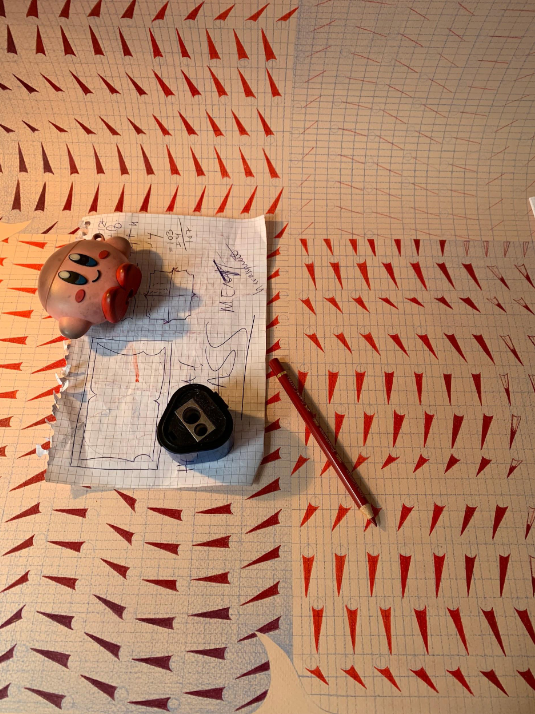
You are aware of this. You have, in fact, used such methods before, and with success. The results are
efficient, clean, and entirely predictable, which is often what is required. There is very little to object to in
this arrangement, unless one begins to object to the feeling that nothing has, strictly speaking, taken
place. This is difficult to explain, but easy enough to recognise.

At some point, you notice that the triangles you are drawing are not identical. They are close, certainly,
but each contains a small deviation: a line that leans slightly, a corner that tightens or loosens without
instruction. These are minor differences, and in most circumstances would not be worth remarking upon.
Here, however, they begin to matter. The act of drawing, which at first appeared repetitive, reveals itself
to be something else. Not variation exactly, and not quite repetition either, but something in between,
something that requires attention in order to be noticed at all. You find yourself continuing, not because
there is a clear outcome in mind, but because stopping would leave the process unresolved in a way that
feels unsatisfactory, though it is unclear why.

They are not the same, but they are close enough that no one would reasonably object. Still, you notice.
What keeps you going is not especially clear. It may be momentum, which once established has a way
of presenting itself as necessity. It may be a habit. It may be the quieter assumption that continuing is
easier than stopping, which is not always true but often feels true enough to proceed.
You tell yourself, at various points, that this is discipline. Or attention. Or something resembling practice.
These explanations are not untrue, but they are not sufficient, and you are aware of this in a way that
does not interrupt the work but accompanies it.

The hand begins to ache more insistently. The back settles into a steady discomfort that does not
escalate so much as persist. The body, which has until now been largely cooperative, begins to offer its
own opinion on the matter. Eventually you stand up.

You look at the page properly, not as something you are in the middle of making, but as something that
already exists. And the question arrives, not dramatically, but with the quiet persistence of something
that has been forming for some time: why are you doing this when you do not have to?

You are not unfamiliar with repetition of a more efficient kind. You come from a printmaking background,
where repetition is not incidental but embedded into the structure of the process itself. One image is
never simply one image. It implies multiples. It anticipates them. The system is designed so that the
hand does not need to remain present in every instance of production, only at the point of its
conception. After that, the process continues with a reliability that requires very little negotiation.

You understand this logic well. You have studied it, worked within it, and, at times, relied on it entirely.
There is a particular satisfaction in it. The plate is prepared, the registration aligned, the ink distributed
evenly across the surface. Once everything is in place, the press performs its function with a kind of
quiet authority. The image transfers cleanly, again and again, with only minor adjustments. It is efficient,
controlled, and, importantly, predictable.

This predictability is not a flaw. In most circumstances, that is the point. It allows for clarity of intention
and consistency of result. It removes the need to renegotiate each mark as it appears. The work
progresses quickly. Decisions, once made, do not need to be revisited. In a single day, it is entirely
possible to produce multiple resolved images, each carrying the same information, each arriving at the
same conclusion.

And yet, there is a point at which this begins to feel insufficient, though not in any way that is
immediately easy to justify. The images are not unsuccessful. They function exactly as intended. There is
no visible error to correct. Still, something in the process feels as though it has been abbreviated.
It is not that nothing has happened, but that too little has been required to make it happen. The distance
between intention and result becomes so short that the work does not have time to resist. It does not
slow you down. The image arrives almost as quickly as it is conceived, and in doing so, it bypasses a
certain kind of engagement that is more difficult to describe but easy enough to recognise in its absence.
You begin to suspect that the speed of production allows the image to be completed before it has been
fully understood. That it passes through the process too cleanly, without encountering enough friction to
alter it, or you. It is, in a sense, swallowed whole.

This is not a rejection of the process. You continue to value it for what it allows. The precision, the
multiplicity, the ability to hold an image steady across iterations. But it introduces a question that does
not resolve itself within the system it belongs to: not whether the work is successful, but whether the act
of making it has been sufficiently inhabited.

There is, perhaps, a need for a certain amount of time to pass between the appearance of an idea and
its resolution. Not as a matter of delay, but as a condition of understanding. When that interval is
shortened too drastically, the work risks arriving before it has been properly encountered. It is
completed, but not necessarily absorbed. The process does not provide enough resistance for the idea
to be examined from multiple positions, to shift under the pressure of repetition, or to reveal aspects of
itself that were not present at the outset. In this sense, the speed of production begins to resemble a
form of bypassing. The image is realised, but not fully digested.

You return to the triangles, though it is no longer entirely accurate to describe what follows as repetition.
The structure remains the same—three lines, joined in sequence—but the longer you continue, the less
stable that sameness appears.

At first, the differences register only intermittently: a line leans slightly more than intended, a corner
closes too tightly or not enough. These are minor deviations, easily dismissed in isolation. But they begin
to accumulate, not in a way that produces dramatic change, but in a way that resists the assumption
that nothing is changing at all.

It becomes difficult to maintain the idea that you are repeating the same action. The hand does not
return to a neutral state between attempts. Each triangle is informed, however subtly, by the one that
preceded it. The process begins to carry its own memory forward.

With enough time, the act shifts again. The triangles themselves become less central than the
differences between them. What holds your attention is no longer the form, but the slight instability
within it. You begin to look for these deviations, not as errors, but as evidence. The repetition, which
initially suggested uniformity, starts to function as a way of detecting variation that would otherwise
remain imperceptible.

In this sense, the act is no longer simply producing triangles. It is tracking something that does not fully
stabilise—a movement, perhaps, or a tendency that only becomes visible when the same structure is
held in place long enough for its inconsistencies to emerge.
At a certain point, it becomes difficult to say what the triangles are for. They continue to appear, one after
another, maintaining the same basic structure, but their function begins to feel secondary to the act that
produces them. They are no longer the objective so much as the condition that allows something else to
take place.

You could stop drawing them. Nothing would be lost in any practical sense. The page already contains
more than enough to demonstrate what a triangle is and how it behaves. And yet, stopping does not feel
equivalent to finishing. It feels closer to interruption.

The work is not located in the accumulation of forms, nor in their resolution as a final image. It resides
somewhere within the duration of the act itself, in the sustained attention that repetition makes possible.
The triangles function less as outcomes and more as a mechanism. They hold the process in place long
enough for something less immediate to emerge.

What that something is does not present itself clearly. It is not a conclusion, nor a result that can be
extracted and set aside. It is closer to a shift in relation. The hand no longer moves toward a predefined
end, and the image no longer serves as proof of completion. Instead, the act continues under its own
momentum, carrying with it a form of attention that is difficult to access under more efficient conditions.

Seen this way, the question is no longer why one would choose to draw a triangle repeatedly when other
methods are available. The triangle itself has become incidental. And so the process continues, not in
order to produce something further, but because within it, something has already begun to take place
that does not occur as readily outside of it.

 Alice  — warmly invites you to follow her!


  • Instagram — @zak.al

© 2026 — text: Alice Zakharnko, GreatArt UK and Gerstaecker NL editorial team | © 2026 — images: Alice Zakharnko