









Artist and architect Florian Markus creates his paintings using a robotic plotter. After posting a video on Instagram about his painting process a few years ago, his work went viral.
No wonder: a plotter arm moving monotonously back and forth with a brush full of acrylic paint, gradually creating a geometric composition — it’s eye candy you could watch forever! He has now created hundreds of paintings for enthusiasts from all over the world.
He also creates graphic work in this way, such as this pen drawing or this watercolour greeting card.
Florian is a client of GERSTAECKER. We were curious to hear his story, so Robert Rost visited him at his studio in Haarlem. He spoke to him about his working methods and his fascination with efficiency, robots and mass production.
We would like to thank him for his hospitality in welcoming us to his studio and for agreeing to take part in this interview.
► interview — Robert Rost in conversation with Florian Markus ~ on robots & mass production
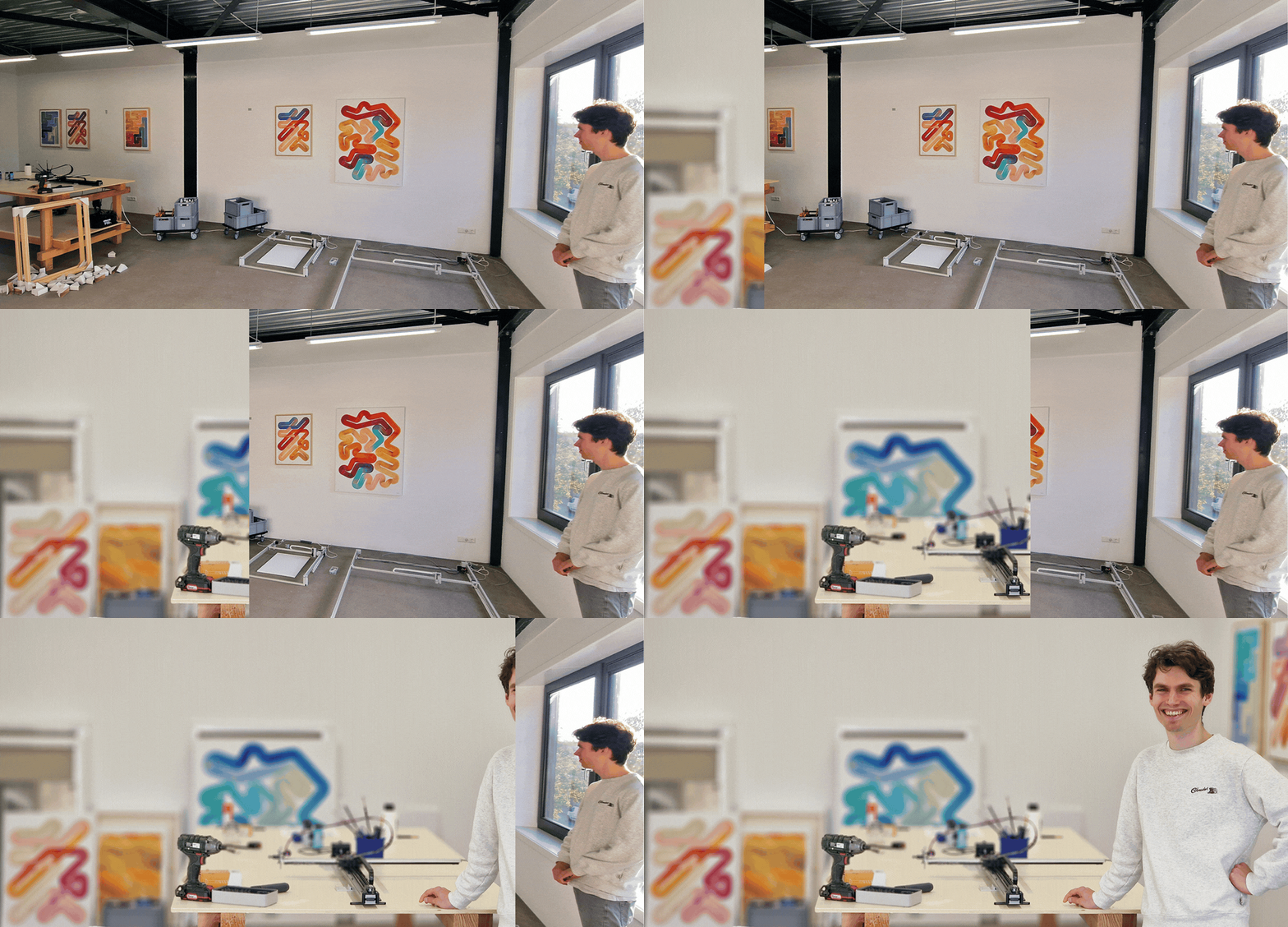
We meet a cheerful artist in a meticulously organised studio in a modern commercial building in Haarlem. On the floor, we recognise the robotic plotters from the well-known videos that always capture the making of his work so beautifully.
Florian Markus — a well-organised studio in a modern commercial building
There are also large stacks of pre-stretched canvases, a cupboard containing various types of acrylic paint, brushes and other materials. Scattered around are a few prototypes for new projects.
Florian remembers it well — one Saturday, a few years ago, he posted a video on Instagram showing his plotter creating a painting. Close-ups of mechanical, robotic movements creating colourful lines with thick paint.

Florian Markus — The whole world is my market
A plotter arm that moves monotonously back and forth with a brush full of paint, gradually creating a geometric composition — it’s eye candy you could watch forever.
The video went viral, was actively shared by Instagram itself and also by major platforms he had looked up to. His account grew significantly and the demand for his work skyrocketed. Two weeks later, he handed in his notice at work to capitalise on his success and focus entirely on his own practice. Since then, he has sold no fewer than 800 paintings to customers all over the world in recent years.
Florian — "I sell my work on my own website, so the whole world is my market."
Florian Markus — I love efficiency
The fact that the studio is organised in this way is clearly no coincidence.
Florian — "I’m all about efficiency. I’ve also optimised all my processes—from the production process itself right through to the photography, posting and publishing. This means I can produce a whole batch in one go and make it available for sale on my website. The same goes for the sales process—I try to make everything as smooth as possible for my customers."
Florian Markus — My art is about robots and mass production
Florian — "My art is about robots and mass production. The fun of automation, you might say. It’s a kind of printing technique I use; that’s why I don’t make posters or art prints, because it falls somewhere between a unique artwork that takes a lot of time to create and a print you can whip up in a jiffy. For example, I only produce works in two sizes."
Florian studied architecture at Delft University of Technology and could often be found in the robotics studio.
Florian — "After that, I focused on 3D printing of facades constructed from individual elements and on improving my skills in software and robot control. The work of a traditional architect didn’t quite suit me, so I decided to focus more on innovative construction methods. My interest definitely lies in robots and moving machinery."
Florian Markus — I try to look at art as an architect would
Florian — "My strategy was to focus on things that were innovative and new. That way, as a newcomer entering the market, you immediately become the specialist. Since I knew everything there was to know about 3D printing and robotics after finishing my studies, I had a unique skill set and was able to secure a job with the best companies.
I’ve managed to combine this wonderfully with my art practice. I use the same software I used as an architect.
Although I now create paintings, I still focus on innovation and robotics, but I’m now doing entirely my own thing. I don’t currently take on commissioned paintings, as this doesn’t fit with my creative process. I do try to use lots of different colours, so that everyone can choose one that suits their interior.
At the moment I’m also working on a new chair, but I’ve got about 100 things I want to try out. The aim of the studio is actually to be a sort of playground, where you can show and try out all sorts of things.
I do always choose things that not only I want, but that also make other people happy. That’s what an architect does too; they work on commission and have to listen very carefully to what a client wants. I actually try to look at art like an architect."
Florian Markus — Half of the painting is created by the robot, and half by me
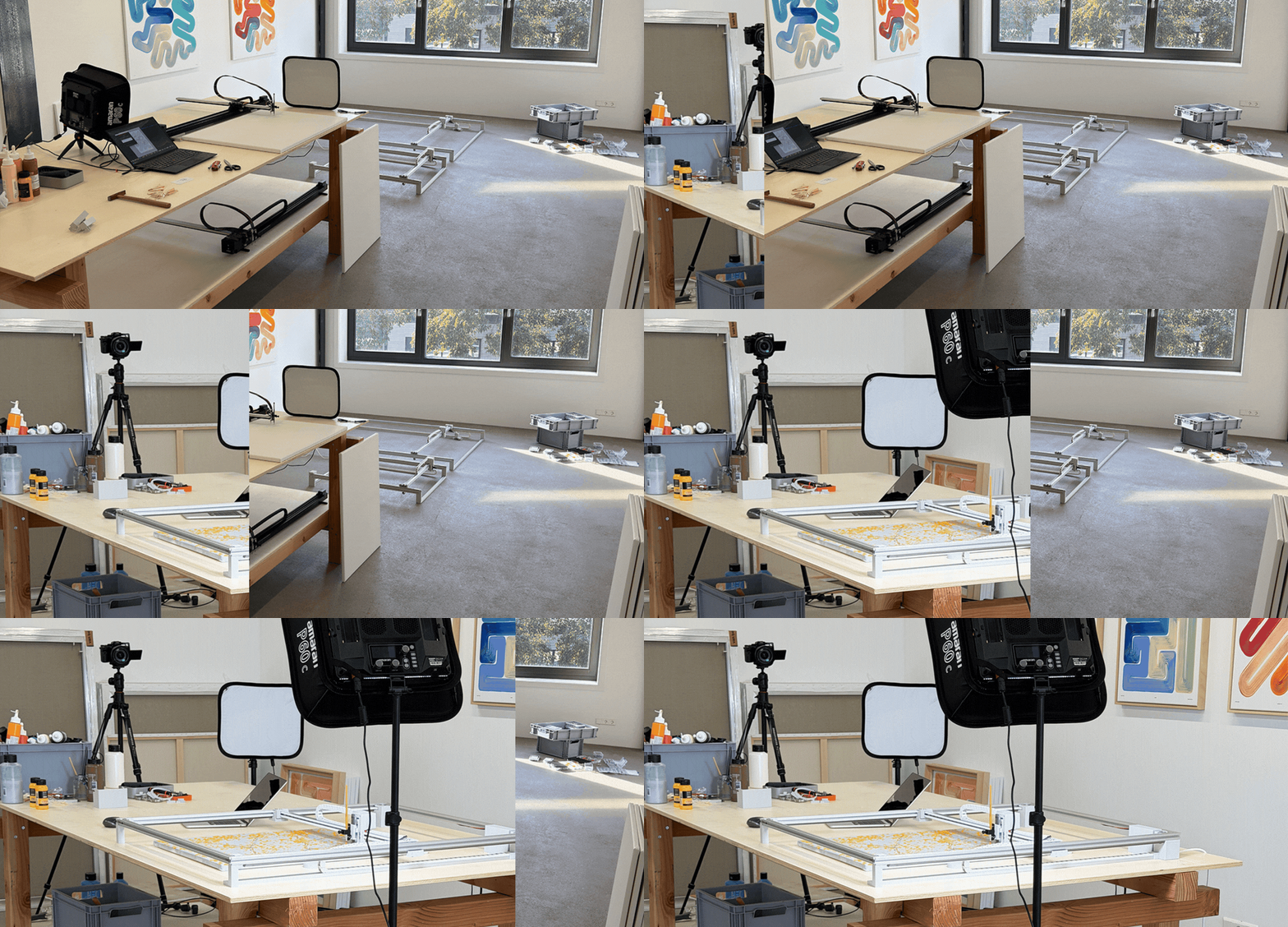
Florian initially worked mainly with existing plotter robots, but has since built a few of his own to specification. He inputs a code containing coordinates, which the robot follows with the brush as a path across the canvas. This is how the composition and form emerge on the canvas, shaped according to the design he had previously created himself as a digital drawing in a computer programme.
Before the paint is applied by the robot, it first sketches the drawing in pencil on the canvas in an initial run. Florian then manually places dots of paint at regular intervals, which the plotter will later pick up with the brush and smear out.
Robert — "How do you actually view your own creative process? You call it painting, even though it’s actually the robot holding the brush."
Florian — "Half of the painting is created by the robot, whilst for the other half I am responsible for the design, setting up the process and selecting the materials and colours — all in all, it’s a combination of hi-tech and low-tech."
All the decisions you would traditionally make during the painting process – such as observing, assessing and taking action – I’ve actually already made before the plotter robot springs into action. So, in fact, I’ve had to go through just as many steps as a conventional artist.
The creative process does differ from traditional painting, but I’m just as hands-on. The steps are simply larger, and after each piece I can tweak and adjust certain aspects. The aim is to experiment as much as possible in the process.
I’ve also decided not to paint pixels. That’s fun and looks nice, but this is closer to real painting, and painting pixels is just like printing and has been done so many times before.
What’s more, the brush creates all sorts of irregularities in this way that you can’t simulate with a computer programme. That makes every piece unique."
Florian Markus — It’s about the whole process, not just the canvas
Robert —
Florian — "It’s brilliant when you finally press the button and see the work come to life. And I’m actually selling the whole process, not just the canvas."
"Because I was watching this process with such intense focus and fascination, I decided to film it and post it online later. At exhibitions, I always present the robot I’ve built myself; it’s simply part of the whole experience."
Robert — "Why do you think people, just like you, find this process so wonderful to watch, given that it really strikes a chord with such a wide audience?"
Florian — "I think that making things is the very "Making things is what it’s all about. Even if you’re a bit clumsy, we still really enjoy making things. Making things is also something we really miss in today’s society; we’ve outsourced everything these days. But making things is really in our DNA. That’s why I think people like watching things being made, just like with my videos."
Florian maintains a database that serves as a comprehensive archive of all his sold works. Each work is documented to record its history, context and development within his practice.
By maintaining this archive, he makes the journey of his studio work transparent and accessible. Collectors, galleries and visitors can discover the development of forms, colours and concepts over the years. Think of it as a growing register of everything that has left his studio. Below are four examples. Want to see more? Take a look here!
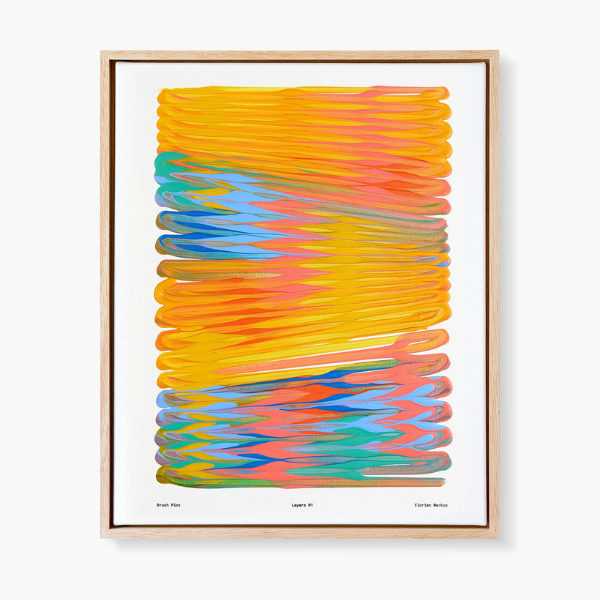
Layers 01 explores a collaboration between human and
machine. I place the paint while the robot moves the brush, creating a shared
authorship in which neither fully controls the outcome.
Rather than aiming for perfection, our roles are
deliberately interdependent: the robot’s programmed precision meets my
intuitive decision-making. The work emerges as an accumulation of actions,
where intention and execution continuously shift between human and machine.

Sakura marks a shift toward more figurative work.
Using my self-built plotter, I explore new ways of working with a brush,
focusing on the stroke itself.
The machine follows a complex path generated through my
own G-code, translating the intricate form of a sakura tree into movement. This
natural subject contrasts with the rigid logic of the system—an unexpected
tension that drives the work.
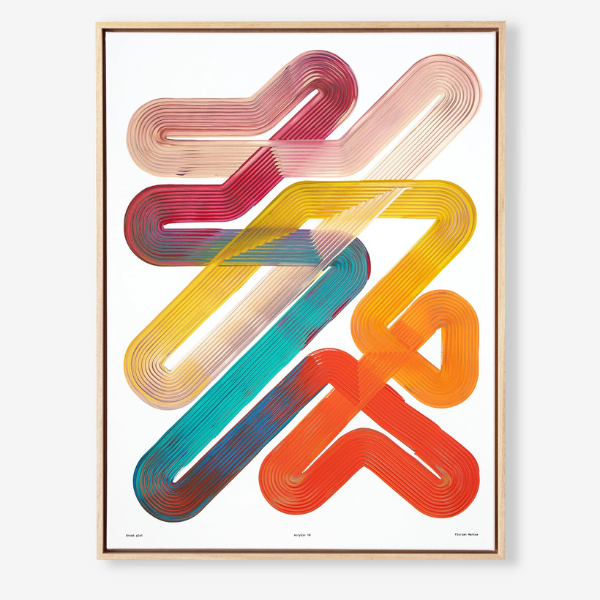
Brush Plot reimagines the paintbrush within a
Cartesian system. Using the machine's binary precision, the painting reveals
spontaneous gradients of color. Before applying the paint, I run the script
once with a pen instead of a brush. This process allows me to strategically
place the paint and also creates a satisfying visual foundation that guides the
brush as it traces a deliberate yet fluid line.
The robot painter is a 2-axis machine capable of covering
dimensions of approximately 1300 x 2000 mm. At its end effector, a lightweight
servo motor controls a brush, moving it up and down with consistent pressure.
While the robot’s precise movements generate intricate patterns where colors
seamlessly merge, the application of paint remains manual.
This creates a collaborative process—a partnership
between myself and the machine. The result is a harmonious blend of
methodical robotic precision and the natural unpredictability of flowing
acrylic paint. This interplay of control and spontaneity produces artworks that
are both intricate and dynamic, reflecting the convergence of human creativity
and technological innovation.
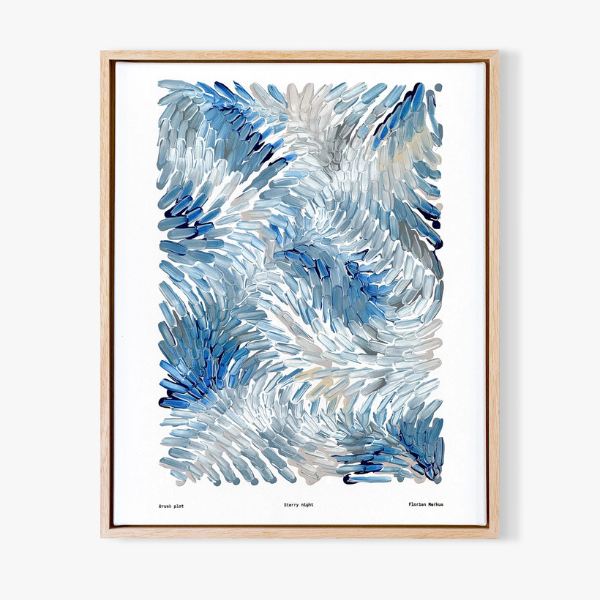
Van Gogh’s technique is endlessly fascinating. His rapid, intuitive approach involved working with wet paint, allowing colors to merge and interact through bold, dynamic brushstrokes. This method created a sense of movement and emotion that remains unparalleled. While the Pointillists of his era meticulously calculated the interplay of colors, Van Gogh abstracted motion and form, breathing life into his canvases in a way that continues to inspire artists worldwide.
Here in the Netherlands, we are fortunate to have many
opportunities to see Van Gogh’s works in person, and I have visited these
collections countless times. His art inspired me to explore ways of capturing a
similar sense of motion and energy using modern tools, such as a vector
field.
In my work, I use Perlin noise to create a rotating wave
that moves at a steady, constant rhythm. Though the visual appearance may seem
dynamic, it is driven by a precise, consistent motion, giving the piece a
clean, structured flow.
Much like in my other pieces, the paint is applied by
hand, ensuring a personal and expressive touch. This interplay of emotion and
technology creates a distinctive harmony in my work—a modern homage to Van
Gogh’s timeless genius.
► the making of video's — fascinating eye candy ~ and don’t forget the sound!
It’s his videos that have made Florian world-famous almost overnight. And rightly so – they’re fascinating eye candy! Here’s a small selection. Want to see more? You can find them on Forina’s Instagram and YouTube. TIP! Don’t forget to turn on the sound for the first two videos...
— Sakura Collection ~ and check out that sound!
— another one ~ for the sound if nothing else!
Florian Markus — In the end, it’s the colours that matter most
Here at GERSTAECKER, we’re very curious to find out which materials Florian actually uses to create his paintings, so we take a look at the cupboard filled with pots and bottles of acrylic paint from various brands. We immediately notice that our own-brand NEO acrylic paint is among them.
Robert — "What factors influence your choice of materials, and to what extent are analogue materials important?"
Florian — "The brush must be of good quality and suitable for the task at hand. I use different types of paint for the colours; I’ve now learnt which ones work well and blend smoothly together. I’ve also developed a sequence of colours that blend well, but wouldn’t work if applied in the reverse order. How the colours blend is really the only thing that determines whether a painting turns out well or not.
The matt finish of the colours I use ensures that they look beautifully fresh and light. This works beautifully with the white of the canvas.
I also like to add grey to certain colours. And I prefer to work with the colours straight from the bottle, so without mixing them. That, in turn, has to do with the efficiency I love.
The fluidity of the paint is also very important. Here too, I prefer not to dilute it, so that no differences in viscosity arise due to my own intervention.
Ultimately, the colours are the most important thing. Whether it’s beautiful depends mainly on the colours, so which ones I choose. I deliberately choose colours that are appealing, cheerful and look good in an interior."
► We don’t have robotic plotters, but we do have everything else — a few suggestions
► Studio RAP Rotterdam — a portfolio of projects Florian has worked on
.png)
Florian has worked at Studio RAP in Rotterdam, an architectural practice — comprising architects, designers, robotics experts, programmers and researchers — that combines computer-aided design (CAD) with innovative digital fabrication methods. Here you can see a selection of the projects Florian has worked on.
TIP! Be sure to click on the links in the descriptions for more photos and some design drawings — and don’t forget the videos!
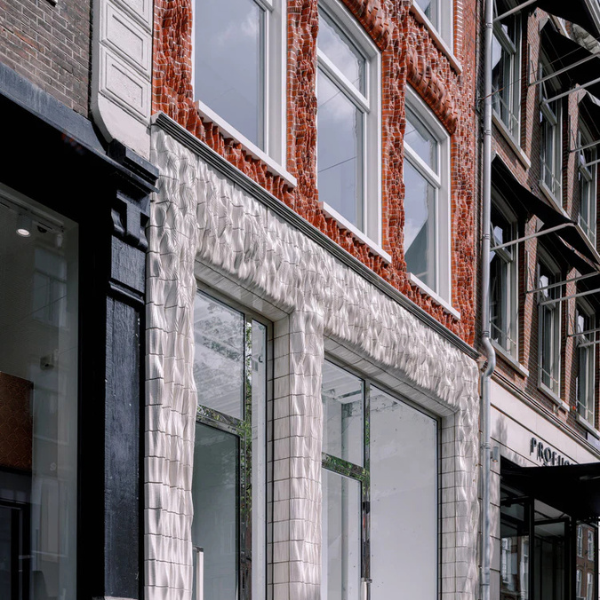
The P.C. Hooftstraat in Amsterdam, renowned as the city’s premier fashion street, has seen a significant transformation in recent years, becoming a hub for architectural innovation as well. Among the notable additions to this transformation are The Looking Glass by UNStudio and The Cristal Houses by MVRDV, both of which have elevated the street's architectural profile.
Studio RAP was commissioned to contribute to this architectural renaissance by creating a 3D-ceramic printed facade. This project involved reimagining the traditional cross-bond brick pattern by integrating stainless steel joints and expressive 3D patterns into the design. To achieve this, Studio RAP developed a novel printing setup capable of fabricating a large quantity of ceramic tiles necessary for the facade. This innovative approach not only highlights the merging of traditional and contemporary design elements but also showcases the potential of 3D printing technology in modern architecture. The result is a striking and unique facade that adds to the street's visual and architectural diversity.
- project name — Ceramic House
- project by — Studio RAP Rotterdam
- partners — Royal Tichelaar Makkum
- scope — Design + fabrication
- parametric tools — Rhino Grasshopper and inhouse software
- fabrication — In-house clayprinting
- date — January 2022
- location — P.C. Hooft Street Amsterdam
► You can find more information here — and don't forget to check out the video!
foto: © Riccardo De Vecchi
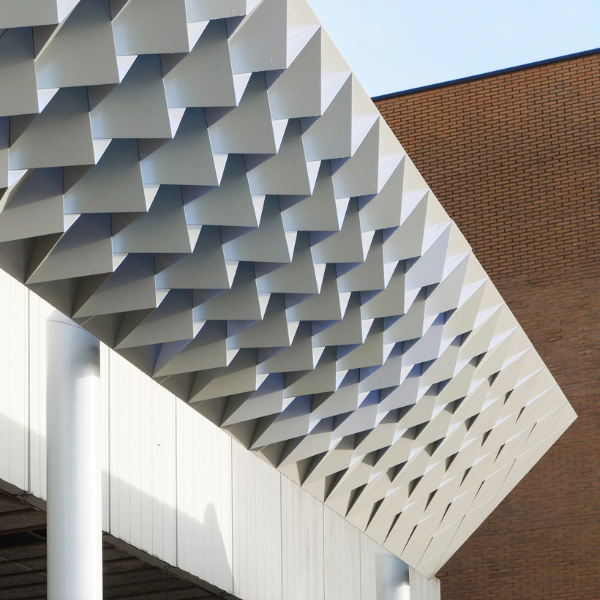
Acoustic cladding increases the comfort in dense cities with traffic. This 3d-shape was created with the same material as was used for Theater Zuidplein. With the use of folding, this aluminum composite material becomes a expressive texture. This project shows the potential of 2D-milling in three-dimensional expressive facades. This technique could be used in many more projects with different parameters and free-form patterns. The silver material has an impressive blue glow that emphasizes the gradient of the acoustic spikes.
The fabrication process involves precise 2D-milling and folding techniques to achieve the intricate 3D texture. Advanced machinery ensures the accuracy and repeatability required for creating the free-form patterns and acoustic features.
- project name — Acoustic canopy
- conducted at — Studio RAP Rotterdam
- client — Heart of South
- partners — Aldowa
- scope — Engineering + fabrication
- parametric tools — Grasshopper
- fabrication — CNC milling/engraving + folding
- date — September 2020
- location — South Square Rotterdam The Netherlands
► You can find more information here!
photo : © Pim Top
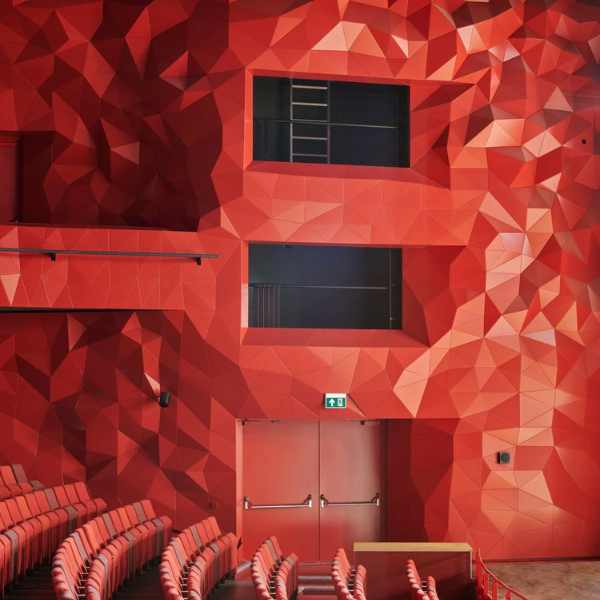
The interior of Theater Zuidplein represents a harmonious blend of advanced generative acoustic simulation and innovative robotic 2D-milling and folding techniques applied to sheet metal. The parametric design process begins by selecting a fixed unit governed by a specific set of rules. For this project, we developed a mesh of parametric triangles. Each triangle unit was informed and transformed through acoustic simulations to generate an optimal sound experience. These triangular units are not only structurally self-supporting but also engraved with detailed information to dictate their precise position, rotation, and folding angles.
- project name — Theater Zuidplein acoustic interior
- project by — Studio RAP Rotterdam
- Client — Hart van Zuid
- Partners — Aldowa + Arup
- Scope — Design + engineering + fabrication
- Parametric tools — Grasshopper + Acoustic optimisation by Arup
- Fabrication — CNC milling/engraving + folding
- Date — February 2020
- Location — South Square Rotterdam The Netherlands
► You can find more information here — and don't forget to check out the video!
photo : © Pim Top
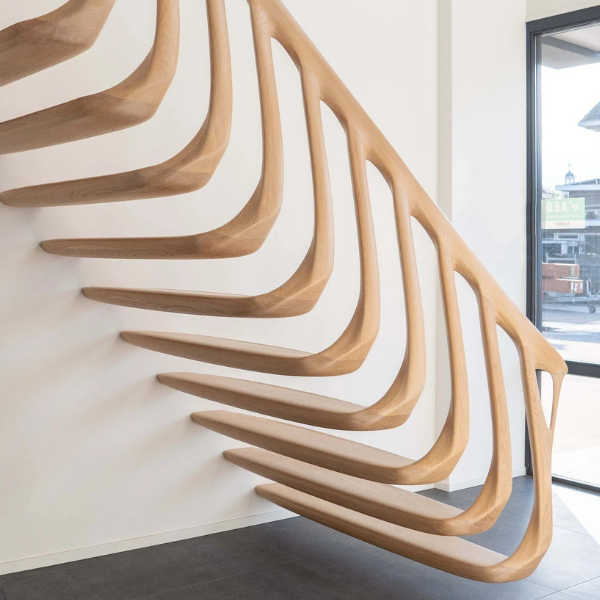
This bespoke timber staircase stands at the entrance of 3D-milling expert Doornekamp Woodspecials in Waddinxveen. Parametric tools proved ideal for designing its organic form. For this project, we developed a Grasshopper script to generate the steps and balusters, transforming their shapes from top to bottom. Rhino’s SubD functionalities enabled the creation of a polysurface tailored to this unique design. The staircase exemplifies the synergy between parametric design and digital fabrication. Spline modeling with SubD aligned perfectly with the capabilities of the 5-axis milling machine. Supported by a steel frame within its wooden envelope, the staircase maintains remarkable stiffness and remains vibration-free despite its slender profile.
The staircase has a parametric design approach. Every step is morphed according to a curve to make the staircase flow. It becomes more dynamic, because of these organic curved shapes. Modeling this slender shape was a fine line between overall stiffness of the staircase and weightless appearance.
- project name — Parametric staircase
- project by — Studio RAP Rotterdam
- partners — Doornekamp Woodspecials
- scope — Design + 3D modeling
- parametric tools — Rhino Grasshopper and Rhino SubD
- fabrication — CNC milling with 5-axis milling machine
- date — January 2021
- location — Waddinxveen The Netherlands
► You can find more information here — and don't forget to check out the video!
foto: © Florian Markus
► over Florian Markus — somewhere between art & architecture
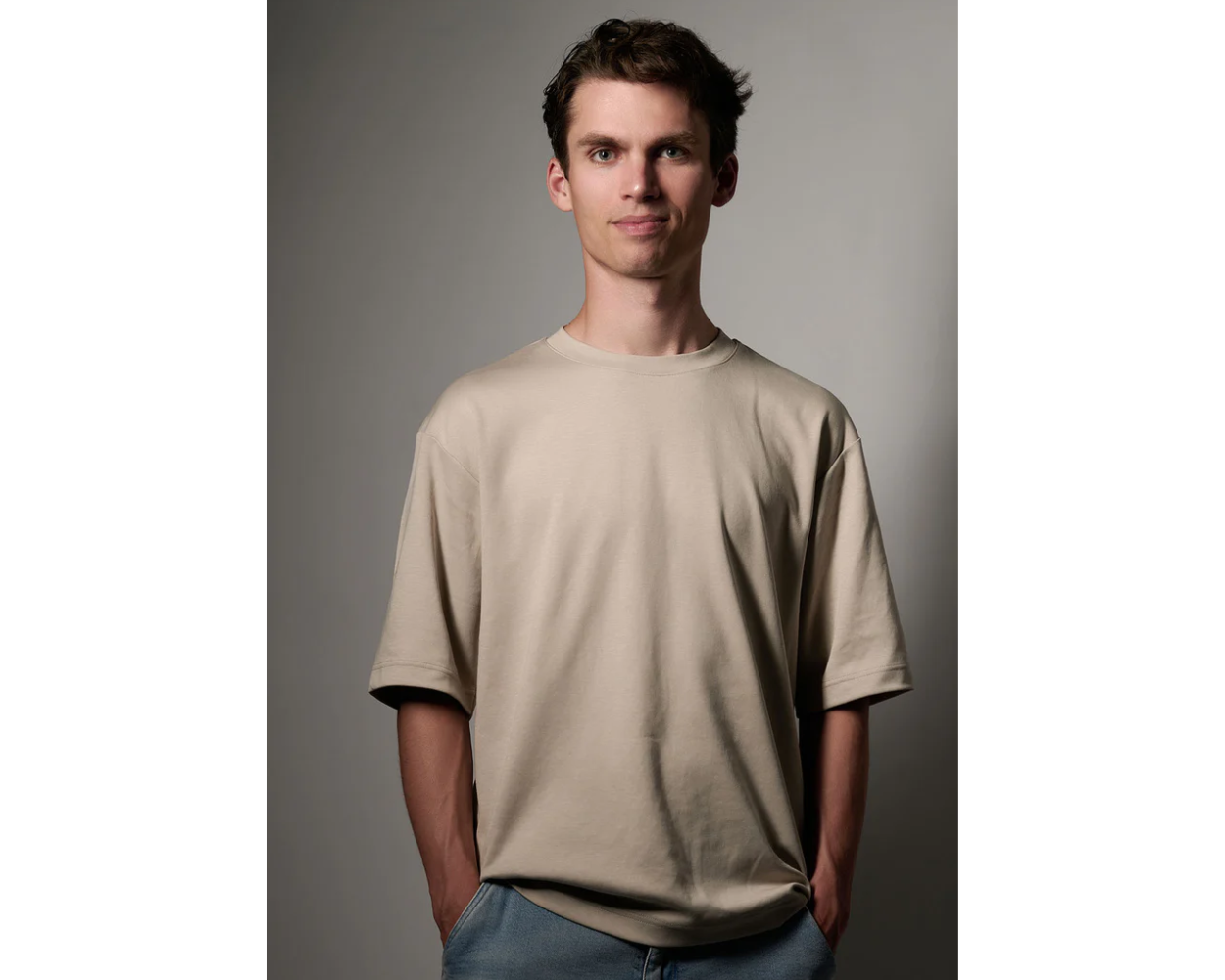
Florian Markus is an architect and artist based in Haarlem, The Netherlands. Somewhere between art and architecture, he challenges digital fabrication technologies to create craftsmanship for the future.
His work explores how digital fabrication can move beyond standardised production, opening up new avenues for creativity and material innovation. In his projects, Florian juxtaposes material and fabrication, exploring the tension between traditional craftsmanship and modern techniques.
By rethinking the role of technology in design, Florian seeks to bring the maker closer to the process, blending precision with a sense of authenticity. His projects aim to break down traditional barriers, fostering a direct dialogue between concept, creation, and craft.
Through his practice, Florian envisions a future where technology enhances creativity, enabling designs that are both unexpected and deeply connected to the act of making.


Robert Rost is a professional painter who lives and works in Rotterdam. In addition to his painting practice, he has extensive experience in teaching painting materials and techniques. He has taught at the Willem de Kooning Academy in Rotterdam and founded The Fine Art Collective in the Netherlands, through which he has spent many years supporting numerous art schools and artists with workshops and projects on the use of materials, in collaboration with museums and professional artists.


© 2026 — text: Florian Markus, Studio RAP, Robert Rost & Gerstaecker NL editorial team | © 2026— images: Florian Markus, Studio RAP, various artists, Robert Rost & Gerstaecker NL and GreatArt UK editorial team